


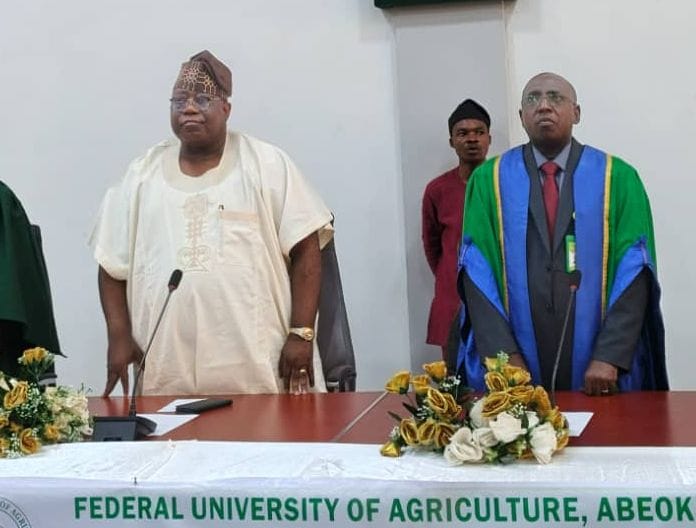
The Chairman, Federal Civil Service Commission FCSC), Prof. Tunji Olaopa, has urged universities to rediscover their essence in order to effectively contribute to national development.
Olaopa spoke on Friday as the Chairman of the 2026 Convocation Lecture of the Federal University of Agriculture ( FUNAAB) , Abeokuta, Ogun State.
The essence of education , and university education specifically, according to Olaopa, is far from the existing preoccupation with the furnishing of graduates with certificates for employment.
To him, the fundamental essence of university education is to equip graduates with the skills to live as human beings and contribute to the well-being of society among fellow citizens.
According to him, a redefinition of the essence of university education has become imperative in view of
Nigeria’s dismal youth unemployment statistics. To him, the statistics only reinforce the notion that university education is not doing for the youths what is expected .
“They are not only unemployed and unemployable, they are also to be found in the worst of crimes and countercultural tendencies and activities”, he said.
Stressing the need for a proper understanding of the essence of university education, Olaopa drew from the ideas of Wendel Berry about education.
Olaopa quoted Berry as having said: “The thing being made in a university is humanity…. [W]hat universities…are mandated to make or to help to make is human beings in the fullest sense of those words–not just trained workers or knowledgeable citizens but responsible heirs and members of human culture…. Underlying the idea of a university–the bringing together, the combining into one, of all the disciplines–is the idea that good work and good citizenship are the inevitable by-products of the making of a good–that is, a fully developed–human being.”
Thus, for Olaopa, the first and most significant essence of education is to enable students to become fully human, to reconnect back to their collective humanity, and more importantly, the imperative of learning to learn.
“When we learn, we do not only do it towards the end of the acquisition of skills and competences (or of certifications and degrees) but also towards learning to live and relate together. This is the most cogent ethical component of learning that the university system must take note of”, he said.
To Olaopa, such learning negates a situation where a society is divided by religion, ethnicity, status and gender, adding that learning is also done in order to be able to anticipate circumstances, challenges and limitations that life and environment might throw the individual or the state.
“The challenge therefore is to reform the reform of the university system by achieving a strategic balance between the need for manpower development and character development plus ethical relations with others. In terms of change management, the challenge demands that we connect between the significance of STEM education and the necessity of liberal arts, humanities and social science education.”
Urging a paradigm shift in education, Olaopa noted the need to deepen university’s autonomy “in ways that not only shield it from political contestations but also allow it to generate initiatives arising from its constitutional mandate.”
For him, the second governance imperative is the need to drive the university towards a sustainable financing that connects with a national financing model that grounds the university’s autonomy through the governing councils to deal with its own issues and objectives.
According to him, the issue of funding also connects with the need to articulate a university-industry—public-private partnership programme— that fuses with the research and development (R&D) framework for pushing development projects and programmes.
He said this was even more cogent for specialized universities like FUNAAB that have the government breathing down their neck to facilitate core economic and development policies and projects.
To him, there is also the need to address the recurring issue of industrial relations vis-a-vis the Academic Staff Union of Universities (ASUU) . He noted that a more developmental approach was needed to counter the adversarial trade disputes that have more often than not undermined Nigeria’s tertiary institutions and their ability to capitalize human capital development for economic progress.