

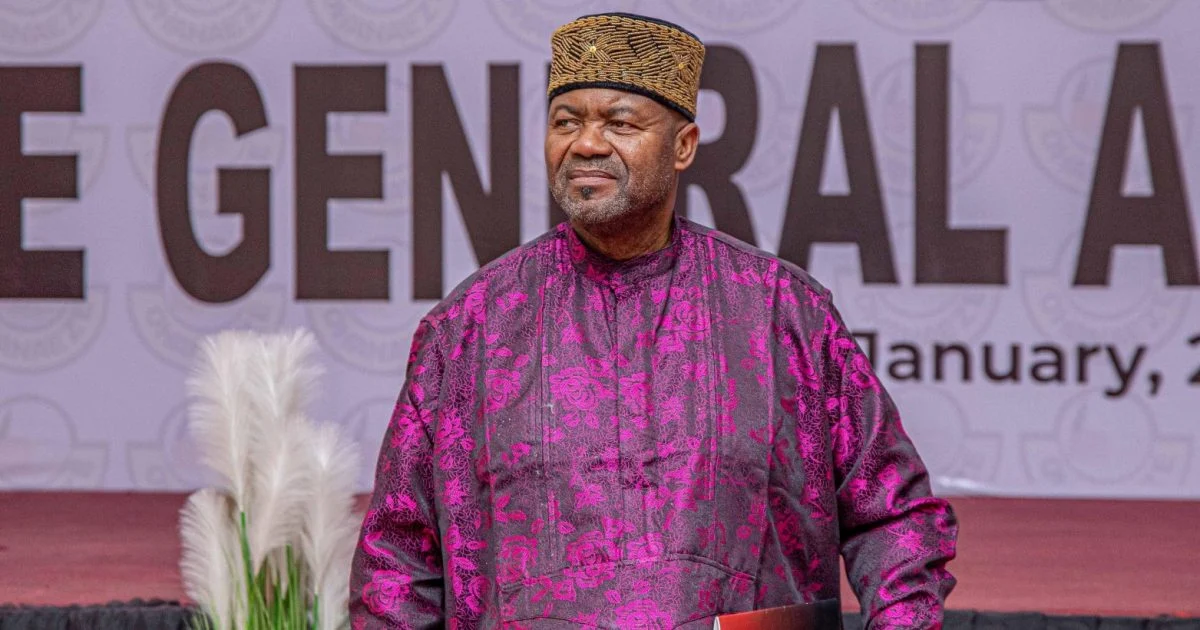

The President-General of Ohanaeze Ndigbo Worldwide, John Azuta-Mbata, has called on the Federal Government to prioritise adequate and sustained funding of the South-East Development Commission as a means of promoting national reconciliation and addressing long-standing grievances in the region.
Azuta-Mbata made the call on Wednesday at the ongoing four-day South-East Vision 2050 Regional Stakeholders Forum in Enugu, describing the commission as a tangible demonstration of the Federal Government’s commitment to equity and justice.
The forum, which began on Tuesday, is aimed at charting a unified socio-economic development roadmap for the South-East and repositioning the region as a global industrial hub by 2050.
It has attracted governors, private sector leaders, professionals in the diaspora and other stakeholders.
While acknowledging the South-East’s significant contributions to Nigeria’s growth through innovation and entrepreneurship, the Ohanaeze leader said feelings of exclusion and neglect had persisted in parts of the region.
“It would be dishonest not to acknowledge that over the years, feelings of exclusion, neglect and unresolved grievances have taken root in parts of our region. If left unaddressed, these sentiments can weaken national cohesion,” Azuta-Mbata said.
He stressed that the importance of the SEDC goes beyond infrastructure development, describing it as a critical instrument for reconciliation and healing.
“I respectfully appeal to the Federal Government to fully utilise the South-East Development Commission by providing it with appropriate and sustained funding.
“This will not only accelerate development, but also help assuage lingering ill feelings, rebuild confidence and heal old wounds in Igboland,” he added.
Earlier, the Managing Director of the SEDC, Dr Mark Okoye, said the South-East is currently burdened by an infrastructure deficit estimated at about $10bn, underscoring the need for regional collaboration.
Okoye urged the five South-East states—Abia, Anambra, Ebonyi, Enugu and Imo—to pursue large-scale, bankable projects collectively rather than compete for limited investment capital.
“The signal sent by the physical and virtual presence of Igbo professional groups from across America, Europe and Asia underscores a collective readiness to rebuild the regional economy,” he said.
He disclosed that the region receives an estimated $4bn annually in diaspora remittances, which, according to him, should be channelled into legacy projects such as regional gas pipelines and other critical infrastructure.
Also speaking, development practitioner Betty Anyanwu-Akeredolu, challenged stakeholders to ensure that the Vision 2050 agenda delivers tangible benefits to rural communities.
“Vision 2050 must move from paper to practice. Development is bigger than party lines; it is about people,” she said, adding that women and youth must be central to the implementation of the vision rather than treated as an afterthought.
Representing Enugu State Governor, Peter Mbah, the Secretary to the State Government, Prof Chidiebere Onyia, welcomed participants and emphasised that no single state could achieve transformational growth in isolation.
He affirmed Enugu State’s commitment to a people-centred, innovation-driven and private sector-led development model.
The forum continues on Thursday with technical sessions focusing on priority sectors such as agriculture, transportation and the digital economy, to produce a comprehensive development roadmap to guide the region over the next 25 years.
Ohanaeze Ndigbo is a pan-Igbo socio-cultural organisation in Nigeria that also operates as a political platform, with members and representatives drawn from various states across the country.
The group is established to articulate, protect and promote the collective interests of the Igbo people, while serving as an umbrella body that brings together Igbo political parties and stakeholders both within Nigeria and in the diaspora.