Peter Uzoho
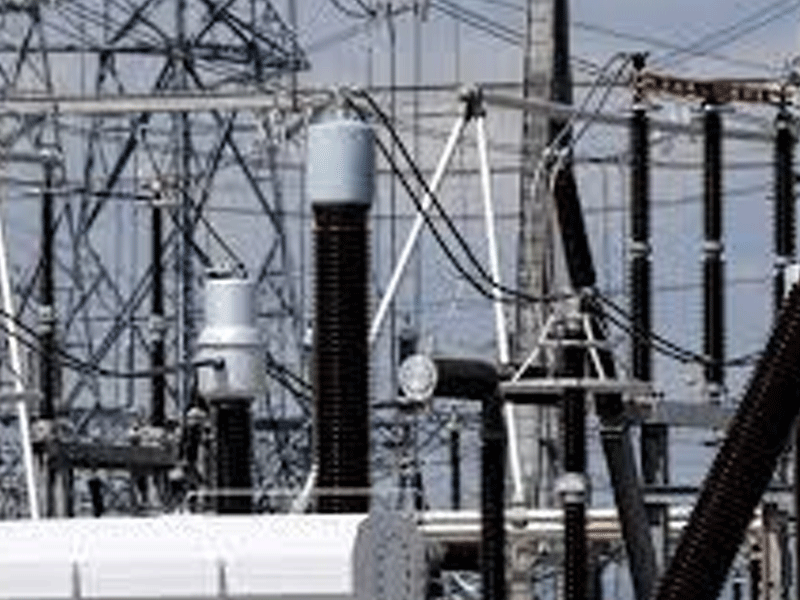
Nigeria’s national electricity grid collapsed again Tuesday, plunging the country into a nationwide blackout and marking the second system failure recorded in 2026 within one week.

The last grid collapse was recorded last Friday.
Embarrassingly, today’s incident happened at exactly the same time the federal government’s N501.021 billion bond under the N4 trillion Power Sector Multi-Instrument Issusnce Programme was being signed in Lagos by relevant government authorities, generation companies (Gencos) and issuing houses for the settlement of the legacy debt owed Gencos.
Some of the government representatives at the event included the Special Adviser to the President on Energy, Olu Verheijen; Chairman of the Nigerian Electricity Regulatory Commission (NERC), Dr Musliu Oseni; Managing Director of the Nigerian Bulk Electricity Trading Plc (NBET), Johnson Akinnawo; Director-General of the Bureau of Public Enterprises (BPE), Mr. Ayodeji Gbeleyi; and the Director-General of the Debt Management Office of Nigeria (DMO), Patience Oniha, who represented the Minister of Finance and Coordinating Minister of the Economy, Wale Edun.
The latest national grid breakdown was confirmed by data obtained from the Nigerian Independent System Operator (NISO), which showed that power generation dropped to zero megawatts at about 11:00am Tuesday.
The incident has once again raised concerns about the reliability of Nigeria’s electricity transmission infrastructure, coming just days after a similar nationwide outage earlier in the year.
As of the time of filing this report, there was no official statement from the Transmission Company of Nigeria or NISO on the specific cause of the latest collapse or a timeline for the full restoration of electricity nationwide.
Power generation data from grid monitoring platforms showed a complete shutdown of the national grid during the incident, with electricity supply disrupted across all regions.
Allocation records further revealed that electricity distribution companies were unable to receive power following the collapse.
Data from NISO showed that national power generation fell to 0 megawatts at approximately 11:00 am on Tuesday.
Power allocation records indicated that Benin, Eko, Enugu, Ikeja, Jos, Kaduna, Kano, Port Harcourt, Ibadan, Abuja, and Yola Discos all recorded zero power allocation.
The outage left homes, businesses, and public infrastructure across several states without electricity.
Also, grid monitoring data indicated a gradual restoration of supply in some areas, suggesting the start of a slow recovery process.