President Not Empowered by Constitution to Suspend Governors, Legislators – THISDAYLIVE

•Says exercise of such powers subject to judicial review to prevent arbitrariness, abuse
•Strikes out PDP governors’ suit challenging emergency rule in Rivers

•Verdict an evil wind against democracy, opposition party declares
“Outside a validly declared state of emergency, the president possesses no power whatsoever to interfere with state executive or legislative institutions”
Chuks Okocha and Alex Enumah in Abuja
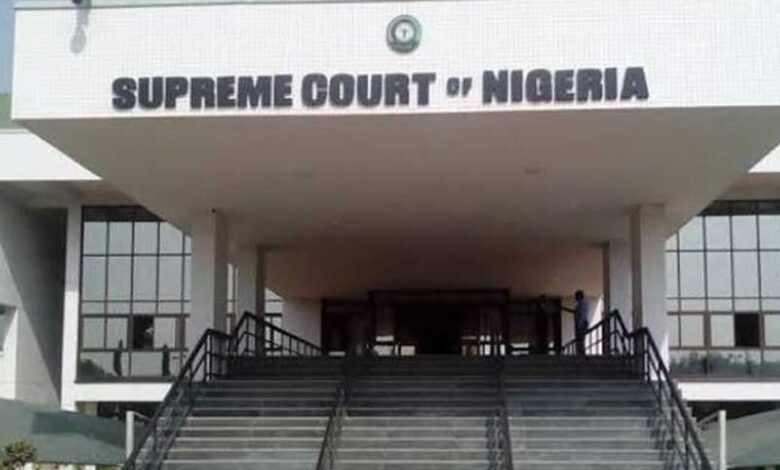
The Supreme Court, yesterday, stated that Section 305 of the Constitution did not confer power on the president to temporarily dissolve executive and legislative institutions of a state during emergency rule.
Alluding to the deliberate silence of the constitution on the spirit of the section 305, the Supreme Court added that the exercise of such powers remained subject to judicial review to prevent arbitrariness and abuse.
The apex court, which delivered judgement in a suit by Peoples Democratic Party (PDP) states against the declaration of a state of emergency in Rivers State by President Bola Tinubu, however, struck out the suit.
Tinubu had in March, citing threat to peace in Rivers State, declared a state of emergency, and, subsequently, suspended Governor Siminalayi Fubara, his deputy, as well as the entire Rivers State House of Assembly members for six months.
Tinubu, in addition, appointed a retired naval chief, Ibok-Ete Ibas, as sole administrator for the state, for the period of the emergency, which lasted six months.
While the emergency was in force, 11 PDP governors had through their states’ Attorneys-General approached the apex court to challenge the powers of the president to suspend elected public office holders, such as the governor of Rivers State and the state lawmakers.
The plaintiffs, in arguing their case, pointed out that they were not denying the president’s power to proclaim a state of emergency, but were challenging “the extent to which the proclamation can be made to affect the offices of the governor, deputy governor, and the State House of Assembly”.
Justice Mohammed Idris, who delivered the lead judgement and went into the merit of the suit, pointed out, “By virtue of sections 4-7 of the constitution, governmental powers divided among the Executive, Legislature and Judiciary, and distributed across the Federal, State, and Local Government tiers.
“No arm or tier of government is constitutionally superior to another, and none may lawfully usurp the powers expressly vested in another.”
While stating that Section 305 of the Nigerian Constitution was clear in its grant of power to proclaim a state of emergency, Idris remarked that the section was silent on the precise content of the “extraordinary measures” that might follow.
He said, “This silence is intentional. Emergencies are inherently situational, varying in scope, intensity, and threat. The constitution, therefore, entrusts the president with discretion to determine the measures required to restore peace and security, subject always to constitutional limits, proportionality, legislative oversight, and judicial review.”
The majority judgement cited the apex court decisions in the declaration of emergencies in 2004 and 2006 in Plateau and Ekiti states, respectively, and that of 2013 in Borno, Adamawa, and Yobe states, to show that emergency powers were not governed by a rigid formula.
It added that the constitutionally permissible response depended on the magnitude of the threat, the functionality of state institutions, and the necessity of intervention to restore constitutional order.
Idris added, “Nevertheless, the President’s discretion under Section 305 is not unfettered. Emergency measures must be temporary, corrective, and proportionate. They must be directed towards restoring constitutional governance, not extinguishing it. Any permanent displacement or abrogation of democratically elected institutions would constitute a constitutional aberration.
“Outside a validly declared state of emergency, the president possesses no power whatsoever to interfere with State executive or legislative institutions.
“On the whole, a proclamation of a state of emergency is constitutionally valid where it is issued under Section 305 of the 1999 Constitution of the Federal Republic of Nigeria (as amended), approved by not less than two-thirds majority of all the members of each House of the National Assembly in accordance with their Standing Orders, and implemented through measures that are temporary, proportionate, and directed at restoring constitutional order.
“The exercise of such powers remains subject to judicial review to prevent arbitrariness or abuse.
“Having clarified these constitutional principles, I reiterate that the instant suit failed to disclose any reasonable cause of action capable of invoking the original jurisdiction of this Court under Section 232 of the 1999 Constitution as amended.
“No justiciable dispute between the federation and any or all of the Plaintiffs’ states has been established.”
The apex court, in the split judgement of six-to-one, held that the court lacked the necessary jurisdiction to entertain the suit brought by the 11 PDP states, which were the plaintiffs in the matter.
According to the majority judgement, the plaintiffs could not establish any cause of action that would warrant the apex court to activate its original jurisdiction to hear the matter.
The apex court held that the court lacked the necessary jurisdiction to entertain the suit and subsequently struck it out.
Idris, who delivered the lead judgement, explained that the plaintiffs failed to show that there existed any actionable dispute between the plaintiffs and the federation to require the court to exercise its original jurisdiction.
According to the judgement, the emergency declaration was not declared in any of the states of the plaintiffs to clothe them with the necessary legal powers to initiate the suit, in the first place.
The apex court, in the majority judgement, having established that the plaintiffs lacked the necessary locus standi to challenge the action of the president in addition to the absence of a cause of action, proceeded to strike out the suit and subsequently dismissed it for want of jurisdiction.
Meanwhile, Justice Obande Ogbuinya, in a minority judgement, insisted that the president could not suspend elected public officials under a state of emergency.
According to Ogbuinya, although the president could declare a state of emergency, he could not use such power as a tool to suspend elected state officials, including governors, deputy governors, and members of legislature.
PDP: It’s an Evil Wind Against Democracy
Peoples Democratic Party (PDP) described the Supreme Court judgement as an evil wind against democracy and its principles.
PDP said though it had accepted the judgement, it was counterproductive to democracy and its principles.
The party said the judgement of the Supreme Court consciously promoted authoritarianism and entrenched tyranny.
In a statement by its National Publicity Secretary, Comrade Ini Ememobong, PDP said, ‘’While we respect the authority of the apex court and recognise its finality within our jurisdiction, we are, nevertheless, compelled to draw attention to the grave dangers that can emanate from the interpretation of the reasoning in this judgement on the political landscape of our country.
‘’Our concern is anchored on the age-long principle of law that the express mention of one thing excludes others (expressio unius est exclusio alterius), and the clear constitutional position that no person or institution (other than the State House of Assembly or a court of law) is empowered to remove a governor from office, even temporarily, during the subsistence of a constitutional term.
‘’To hold otherwise is to create a pathway by which a President, with the active support of the National Assembly, can compel political alignment or compliance through the instrumentality of emergency powers in ways not envisaged by the constitution.
‘’We submit that the interpretation of this judgement has the potential to reverse the hard-won democratic gains by unwittingly making state governments completely subservient to the Federal Government, forcing them to seek to ‘connect to the centre’ by joining the ruling party, as we are already witnessing.”
The statement added, “‘More troubling is the fact that the logical extension of this reasoning based on the provision of Section 305(3)(c) ‘extraordinary measures to restore peace and security’ could, in the future, be interpreted to justify the suspension of other constitutional institutions, including the judiciary itself.
‘’We cannot reconcile how in a federation (not a unitary state) an elected President can be empowered to dismantle the democratic structures of a federating unit, sack elected officials and appoint leaders there, without consciously promoting authoritarianism and entrenching tyranny.”
PDP said, ‘’As a political party wholly committed to the protection and consolidation of democracy in Nigeria, we hereby call on the National Assembly to urgently initiate constitutional and legislative safeguards that clearly define and limit the scope of emergency powers of the president, to prevent imminent abuse and preserve Nigeria’s federation.
‘’We also urge Nigerians, civil society organisations, the media, and the international democratic community to remain vigilant in the defence of constitutionalism, federalism, and the sanctity of the electoral mandate.
‘’We remain hopeful that, at the next opportunity, the Supreme Court will have cause to extensively clarify the constitutional boundaries of emergency powers, in the overriding interest of justice, democracy, and the long-term stability of our Republic.”