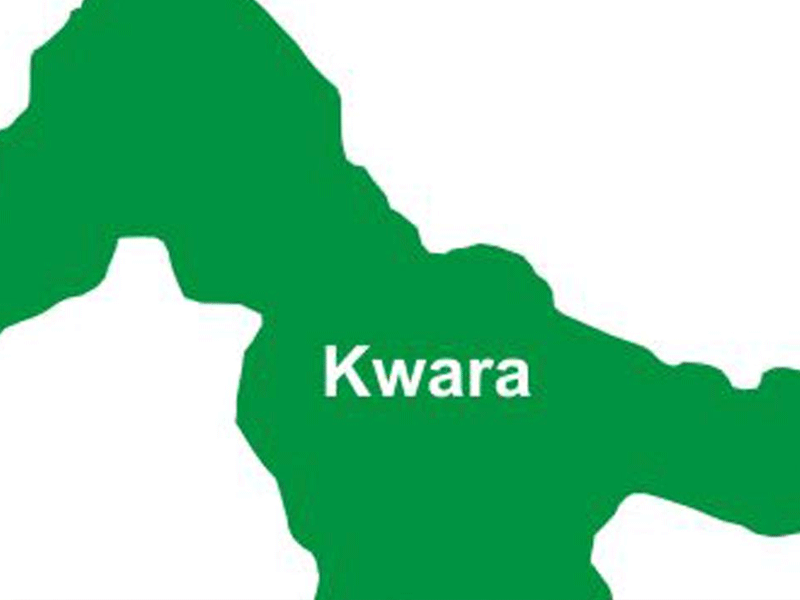


Stanley Nkwocha writes that the quiet Tudun Biri community in Igabi local government area of Kaduna state now wears a new look with the recent inauguration of 133 housing units, educational facilities and state-of-the-art infrastructure courtesy the President Bola Tinubu-led administration.
“A government that keeps its promises is the noblest of all institutions.”
The above quote by an anonymous scholar echoes the ethical and moral viewpoints regarding the nature of good governance, the social contract, and public integrity in Nigeria under the administration of President Bola Tinubu. The idea is that the legitimacy of government is based on the consent of the governed, which implies a, often unwritten, contract to act in the best interest of the citizens.
What is happening in Nigeria at the moment reflects a fiduciary conception of public office, where the state’s highest duty is to fulfill its commitments to the people.
In December 2023 when President Tinubu pledged to rebuild Tudun Biri, a quiet community in Igabi Local Government Area of Kaduna State that was shattered by a devastating military drone misfire, his commitment was dismissed in certain quarters as one of those empty government promises.
But on Friday, January 29, 2026, the once deserted community, which became a mere shadow of its boisterous self, came alive. The president’s promise to rebuild the community, severely hit by an accident bomb from military drones, claiming innocent lives, injuring some, and leaving many in trauma, unfolded into a pleasant reality.
Vice President Kashim Shettima inaugurated the Tudun Biri Resettlement Scheme, with about 133 completed housing units, educational facilities, and other state-of-the-art infrastructure.
When VP Shettima visited victims of the tragedy in December 2023, he could not believe what he saw at Barau Dikko Teaching Hospital in Kaduna, where some of the casualties, most of whom were women and children, were receiving treatment. Palpably, he struggled to hold back tears from rolling down his cheeks. Moved by the pathetic sight, he directed the National Emergency Management Agency (NEMA) to ensure that the victims get adequate relief materials.
Announcing President Tinubu’s pledge to rebuild the community, the Vice President told leaders of the community and other stakeholders in the state that “most importantly, the President approved the commencement of the Pulaku Initiative by next month. The Pulaku Initiative is the President’s unique response as a non-kinetic approach to the challenges in the North West.
“Actually, our intent was to kick off the programme in Sokoto, but in the light of recent development, the President directed that the Pulaku Initiative should be kick-started here in Kaduna State. And Tudun Biri will be the first beneficiary of that scheme. It’s a complete package of solutions as a non-kinetic response to the problems of banditry and kidnapping in the North West,” he added.
The Vice President also informed the community’s leaders about how worried President Tinubu had been over the tragic incident, acknowledging that, away from the number of casualties, it was gruesome to lose even one life. “I am here because the President is deeply concerned. He was deeply touched by what happened. As the late Dele Giwa rightly said, let’s not talk about the numbers; ‘one life taken in cold blood is as gruesome as millions lost in a pogrom,” he stated.
Keeping that promise real, Senator Shettima returned to Kaduna Last Friday to inaugurate the resettlement scheme. A government that prioritizes transparency, accountability, and keeps to its words is seen as an ideal, often contrasted with the reality of unfulfilled promises. This is truly what the inauguration signifies – a testament to the commitment of the Tinubu administration to keeping its promises and delivering results.
The Vice President said the project is an agenda anchored on a simple but powerful notion that governance must serve people, heal divisions, and strengthen the foundations of national stability.
“Today stands as a living demonstration of that principle. The commissioning of the Tudun Biri Resettlement Scheme is an assurance of our collective belief that fairness is the glue that holds a nation together, and that compassion is not a weakness of the state, but its moral strength,” he noted.
The true test of good governance is its ability to deliver on promises regarding human rights, economic development, and social welfare. The Tinubu administration has shown that with commitment, collaboration, and compassionate leadership, even the most challenging projects can be brought to life. The Pulaku Initiative, now referred to as RSPIC, is a shining example of this commitment.
The Federal Government intervention project is aimed at rehabilitating, reintegrating, and resettling internally displaced persons (IDPs). Launched by President Tinubu in July 2024, and overseen by Vice President Shettima, RSPIC is a key component of the administration’s non-kinetic strategy to address insecurity, particularly in the North West and North Central regions.
The initiative moves beyond temporary emergency relief to provide long-term, sustainable solutions, such as building durable homes, schools, and clinics for communities displaced by banditry and conflicts. It is designed to cover seven states initially affected by farmers-herders conflicts and banditry, including Sokoto, Kebbi, Benue, Katsina, Zamfara, Niger, and Kaduna. The scheme includes constructing residential units, roads, clinics, and skills acquisition centers to ensure economic and social reintegration.
It was the pilot phase that was initiated in Tudun Biri, Kaduna State, following the security incident. The project’s success is a result of the collective efforts of the government at the centre and Kaduna State government under Governor Uba.
The impact of the Tudun Biri Resettlement Scheme goes beyond just providing shelter. It is about restoring dignity, hope, and a sense of belonging to the people of Tudun Biri.
As Vice President Shettima noted, “the Tudun Biri Resettlement Scheme is a vehicle for hope for families whose lives were disrupted,” and “a practical assurance that the Nigerian state does not abandon its citizens in times of adversity.”
He added that the scheme is a reflection of the Federal Government’s firm resolve to respond decisively to the outcome of humanitarian conflict and internal displacement across Nigeria.
According to him, the scheme is a vehicle for hope for families whose lives were disrupted, providing a practical assurance that the Nigerian state does not abandon its citizens in times of adversity.
No doubt, the Tudun Biri story is a clear instance of what can be achieved when leaders work together in perfect harmony. President Tinubu’s vision for the community’s reconstruction was more than just a promise; it was a commitment to restoring dignity and hope to the people of Tudun Biri. And he knew exactly who to entrust with the responsibility of bringing that vision to life: Vice President Shettima.
Senator Shettima’s unwavering focus and dedication to the project were instrumental in its success. He worked sedulously to ensure that every detail was taken care of, and that the project was completed in good time.
And Senator Uba Sani, the host Governor, was more than willing to cooperate and provide the necessary support to see the project through to fruition.
What makes the project truly remarkable is the way it was executed. The VP emphasized that the project’s success is a result of collaboration, trust, and shared ownership between the Federal Government, state authorities, host communities, and development partners. Governor Sani praised the President’s compassionate leadership, while acknowledging the Vice President’s oversight, which ensured the project’s timely completion.
In the end, the people of Tudun Biri are the real beneficiaries of this project. They have been given a new lease on life, with access to modern housing, education, and healthcare. The community is thriving, and it’s all thanks to the collective efforts of these leaders.
This is what governance should look like – leaders working together, putting the needs of their people first, and delivering results. It’s a model that can be replicated across Nigeria, and it’s a testament to President Tinubu’s commitment to rebuilding communities and restoring stability under the Renewed Hope Agenda.
-Nkwocha, media aide to Vice President Shettima, writes from Abuja.