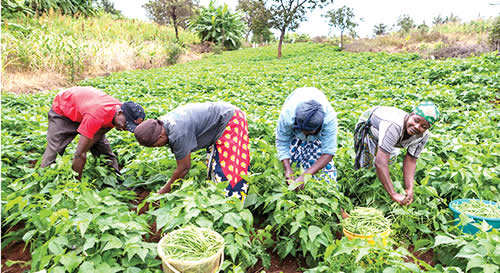

Stakeholders across Plateau and Benue states are calling for an immediate halt to the violent attacks on farming communities, warning that continued insecurity threatens Nigeria’s food supply.
Our correspondent reports that persistent assaults in Bokkos, Barkin Ladi, Riyom, Zaki Biam, Kwande, Logo, and other local government areas have forced many farmers to abandon their fields, disrupting production of key staples such as Irish potatoes, yam, rice, cassava and maize.


According to reports, over 100 people have been killed in the two states in the past three months
Stakeholders argue that ending the attacks will not only save lives but also stabilise food prices and safeguard livelihoods for millions of Nigerians.
Speaking during a workshop organised for the stakeholders in Jos on Friday, the Plateau State Coordinator of Supply Chain Research and Innovation Hub and the Nigeria Food Security Project, Mr Samson Iornongu, stated that the demands for food security are very urgent, especially as agricultural production is increasingly under threat due to insecurity and attacks on farming communities.
Iornongu said that the objective is to build capacity and conduct participatory consultation with farmers, herders, women, youths, and PWDs in Benue and Plateau states to co-developa strategic food security plan for the people.
Iornongu further stated that three LGAs in each of the two states had been selected for the commencement of the pilot phase of an inclusive food security planning initiative in Plateau and Benue states, with support from the United Kingdom International Development–funded Strategic Planning for Resilience in Nigeria Project.
“At the local government level, we are identifying households through baseline assessments of food‑security challenges. A key issue is post‑harvest loss caused by a lack of processing equipment and technology,” Iornongu stated.
He added, “At the core of the SPRiNG Project is inclusive planning that prioritises women, youths and persons with disabilities, acknowledging their vital roles in food systems and community stability, and the pilot phase here in Plateau is being implemented in the Shendam, Mangu and Pankshin local government areas and three other LGAs in Benue
“To address this, we will engage experts from the University’s Institute of Food Security to provide technical assistance and guidance during community workshops, helping reduce losses and improve market structures.
“In this pilot phase, we will select 10 households from each of three communities (30 households in Plateau and 30 in Benue, totalling 60 overall).
“After they attend training and advisory sessions, we will choose the most promising ideas and support their agricultural activities—whether farming, production, or processing—with a small grant.
“If the pilot proves successful, the model will be expanded to other affected local governments across Plateau, Benue, and Nigeria, with the goal of strengthening food security for the wider population,” he said.
The coordinator pointed out that extensive consultations had already been held with the Plateau State Ministry of Agriculture and Food Security, relevant state institutions, academia, traditional leaders, and community stakeholders.
Also speaking, the Deputy Director of Agricultural Services at the Federal Ministry of Agriculture and Food Security, Plateau State Office, Hannatu Ishaku, described food security as a critical response to prevailing security challenges.
She emphasised the need to protect farming communities, noting that they remain central to sustaining food production and rural livelihoods.
Similarly, the national coordinator of the project, Dr Shalem Shiekuma, said the initiative was designed to support communities, even as he further explained that the pilot phase, which will commence in November 2025 and will run for five months, is intended to test approaches that can be scaled up by the state government.
According to him, the project applies a holistic framework that combines policy support, community-level interventions, and data-driven analysis to address the root causes of food insecurity and conflict.
Arewa PUNCH reports that the initiative with the theme: “Enhancing Food Security and Peace-building in Nigeria through Strategic Planning,” is being implemented in partnership with the Benue and Plateau State Governments, and the project is designed to adopt a development-focused approach that integrates agricultural resilience with peace-building strategies.