Wale Igbintade
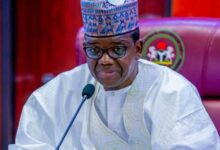
The Economic and Financial Crimes Commission (EFCC) has filed a 16-count charge before the Federal High Court in Abuja against a former Attorney-General of the Federation and Minister of Justice, Abubakar Malami, SAN, his son Abubakar Abdulaziz Malami, and an associate, Hajia Bashir Asabe, over alleged money laundering and unlawful acquisition of properties valued at over N8.7 billion.

In the charge sheet marked FHC/ABJ/CR/700/2025, the defendants were accused of conspiring to conceal, disguise, retain and indirectly acquire proceeds of unlawful activities through bank accounts, corporate fronts and real estate transactions spanning nearly a decade.
The alleged offences were said to have been committed between 2015 and 2025, largely in Abuja, while Malami was serving as the nation’s chief law officer.
According to the charge filed by the EFCC and signed by a prosecution team led by Chief J.S. Okutepa, SAN, Malami and his son allegedly used Metropolitan Auto Tech Limited to conceal the unlawful origin of N1.014 billion kept in a Sterling Bank account between July 2022 and June 2025.
The commission further alleged that another N600.01 million was concealed in the same account between September 2020 and February 2021.
The EFCC also accused the defendants of retaining N600 million as cash collateral for a N500 million loan granted by Sterling Bank Plc to Rayhaan Hotels Ltd, despite allegedly knowing that the funds represented proceeds of unlawful activity.
In another count, the anti-graft agency alleged that between November 2022 and October 2025, the defendants indirectly took control of N1.36 billion paid through the Union Bank account of Meethaq Hotels Ltd, which they allegedly knew to be illicit funds.
Several counts relate to high-value real estate acquisitions in Abuja and other parts of the country, which the EFCC said were carried out to disguise the true origin and ownership of the funds.
The prosecution alleged that N500 million was paid to Efab Properties Ltd for the purchase of a luxury duplex on Amazon Street, Maitama District, Abuja, purportedly for the benefit of Malami.
It was further alleged that N700 million was used to acquire a property at No. 3 Onitsha Crescent, Area 11, Garki, while N850 million was allegedly paid for a property at Plot 683, Jabi District.
The charge further alleged that N430 million was used to acquire a property at No. 3 Rhine Street, Maitama, while another N210 million was allegedly paid for a property located at Cadastral Zone A04, Asokoro District, Abuja.
The EFCC also accused the defendants of concealing N325 million used to purchase a property on Yakubu Gowon Crescent, Asokoro, as well as N120 million allegedly spent on a property at Efab Estate, Gwarimpa.
In addition, the commission alleged that Malami used proceeds of unlawful activity amounting to N537 million and N415 million to acquire multiple properties in Abuja, Kano and Birnin Kebbi between 2018 and 2023. The EFCC maintained that the transactions were structured through proxies and corporate entities to obscure beneficial ownership.
Some of the counts accused the defendants of conspiracy to launder proceeds of unlawful activity, including agreements to disguise the source of funds used to acquire landed properties between 2016 and 2024.
Specifically, Hajia Bashir Asabe, described in the charge as an employee of Rahamaniyya Properties Ltd, was alleged to have played a central role in facilitating property purchases and disguising ownership on behalf of Malami.
The alleged offences were said to contravene various provisions of the Money Laundering (Prohibition) Act, 2011 (as amended) and the Money Laundering (Prevention and Prohibition) Act, 2022, and are punishable under the relevant sections of the laws.
The EFCC listed investigators, bank officials, bureau de change operators and company representatives among its proposed witnesses.
As of the time of filing this report, the defendants have not been arraigned, and the case is awaiting a date for arraignment before a judge of the Federal High Court, Abuja.