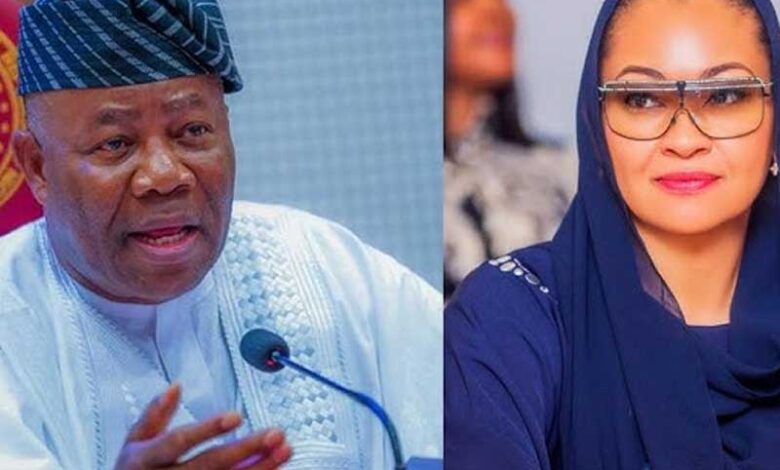
The prolonged face-off between Senate President, Senator GodswillAkpabio and Senator Natasha Akpoti-Uduaghan has exposed deep fissures within Nigeria’s Red Chamber. From suspension and sexual-harassment allegations to defamation suits and international embarrassment, the crisis has tested the Senate’s credibility, free speech, gender justice and institutional accountability, reports Sunday Aborisade.
The first real sign that the storm rocking Nigeria’s Senate might abate came quietly, almost anticlimactically, from the Federal High Court registry in Abuja. On December 12, 2025, the Office of the Attorney-General of the Federation filed a Notice of Discontinuance, formally withdrawing the criminal defamation charges it had instituted against Senator Natasha Akpoti-Uduaghan, the lawmaker representing Kogi Central.

With that single procedural act, the Federal Government brought to an end a prosecution that had come to symbolise the most bruising institutional crisis of the 10th Senate.
Yet, as of Monday morning, the drama was far from being over. While the Federal Government had stepped back, Senate President GodswillAkpabio, who is the prime complainant whose petitions helped trigger the criminal case, had not filed any formal notice withdrawing his own civil defamation suits against Akpoti-Uduaghan.
This was despite the fact that, days earlier, during a New Year church service in Akwa Ibom, Akpabio publicly announced that he had instructed his lawyers to discontinue all such cases, citing a priest’s homily on forgiveness.
Checks by THISDAY in Abuja, however, revealed that the Senate President’s lawyers would possibly announce the withdrawal of the cases on the various adjourned dates at both the Federal High Court of Abuja and the Court of the Federal Capital Territory.
The gap between proclamation and procedure captured, in miniature, the contradictions of a saga that has blended power, personality, law, gender and institutional credibility in unprecedented ways.
The Federal Government’s decision to withdraw the criminal defamation charge marked a dramatic pivot. The case, Charge No: FHC/ABJ/CR/195/2025, had accused Akpoti-Uduaghan of criminal defamation and cyber-bullying over comments she made during a televised interview on Politics Today, in which she alleged that her life had been threatened. The complaints were traced to petitions by Akpabio and former Kogi State Governor, Yahaya Bello.
High-profile witnesses were lined up. Sitting governors, senators, political commentators and activists were all expected to testify.
The case promised to be a spectacle, one that would further entrench the Senate’s internal crisis in the public eye. Instead, the prosecution evaporated.
Acting under Sections 108(1), 108(2)(a) and 108(5) of the Administration of Criminal Justice Act, the Attorney-General’s office discontinued the matter without public explanation.
At the National Assembly, ranking senators whispered of intense behind-the-scenes interventions. According to multiple sources, members of the Senate leadership had sought the intervention of President Bola Tinubu, warning that the feud was spiralling into an international embarrassment that opposition parties were exploiting to batter the administration.
Tinubu, the sources said, was inclined towards peace. The Red Chamber, already under scrutiny over economic legislation and executive–legislative relations, could ill afford a prolonged scandal that questioned its moral authority.
Attorney-General of the Federation and Minister of Justice, Lateef Fagbemi (SAN) was also said to have formally briefed Akpabio on the Federal Government’s decision.
The withdrawal, therefore, was widely interpreted as a political ceasefire – a signal that the state itself no longer wished to prosecute a dispute that had outgrown its original legal framing.
Barely weeks later, Akpabio appeared to reciprocate. On January 1, 2026, he announced that he had directed his lawyers to withdraw nearly nine defamation suits he had filed against various individuals in the course of the controversy. He attributed the decision to spiritual reflection, saying a New Year homily at a Catholic Mass in Uyo had moved him to forgive.
His supporters hailed the move as statesmanlike. After months of brinkmanship, the Senate President, they argued, was choosing reconciliation over retaliation.
But investigations by THISDAY revealed a more complicated reality. As of Monday morning, no formal notice of withdrawal had been filed in respect of Akpabio’s cases against Akpoti-Uduaghan. His wife, UnomaAkpabio, who had also instituted defamation actions, likewise had pending matters at the Federal High Court and the High Court of the FCT.
Legal practitioners point out that in law, intentions do not substitute for filings. Until the notices are entered and adopted in court, the suits remain alive. Feelers, however, indicate that Akpabio’s legal team is expected to formally withdraw the cases on the next adjourned dates, suggesting that the delay may be procedural rather than political.
Still, the episode reinforced the sense that the crisis, though de-escalating, was not yet resolved.
To understand why these withdrawals matter so much, one must return to how the feud began. What initially appeared to be a routine dispute over seating arrangements on the Senate floor escalated into one of the most consequential political confrontations of recent years.
Akpoti-Uduaghan was suspended by the Senate following allegations of misconduct, specifically that she caused disorder during plenary after objecting to a change in her seating position. Senate leadership insisted the action was purely disciplinary, anchored in the Standing Orders.
The Senator disagreed. She claimed her suspension was politically motivated, punishment for her outspoken criticism of Senate leadership. The dispute took a dramatic turn when she publicly alleged that Akpabio had sexually harassed her – an accusation unprecedented in its directness at that level of Nigeria’s political hierarchy.
Instantly, the narrative changed. What the Senate framed as internal discipline became, in the court of public opinion, a test of whether a powerful office holder could be held accountable for alleged personal misconduct.
Akpabio’s response was forceful. He turned to the courts, filing a barrage of defamation suits against Akpoti-Uduaghan and others who echoed her claims. The most striking was a ₦200 billion suit at the FCT High Court, in which he accused her of portraying him as a “sexual predator” and exposing him to hatred and ridicule.
The scale of the claim stunned observers.
Legal analysts warned of a chilling effect on free speech, while civil society groups argued that such suits could deter whistle-blowing, particularly by women in male-dominated institutions.
Akpoti-Uduaghan, on her part, welcomed the courtroom confrontation. She insisted it would finally allow her to present evidence she claimed had been suppressed within the Senate. The courts, she argued, were the first truly neutral arena in the dispute.
As the legal drama unfolded, scrutiny turned inward, towards the Senate itself. The report of the Senate Committee on Ethics, Privileges and Public Petitions that recommended Akpoti-Uduaghan’s suspension became controversial.
Some senators later claimed their signatures had been lifted from an attendance register and appended to the report without explicit consent. Others said they never saw the final draft before it was presented.
These allegations fed a growing perception that due process had been compromised to protect the institution’s leadership. Though the Senate passed a vote of confidence in Akpabio, critics argued that political solidarity was no substitute for transparency.
Editorials in national newspapers warned that the Senate risked deepening its credibility crisis by appearing defensive rather than introspective.
The feud reached its most explosive point when Akpoti-Uduaghan took her case to the international stage, addressing an Inter-Parliamentary Union (IPU) meeting at the United Nations in New York. There, she told delegates that she had been suspended for raising allegations of sexual harassment against the Senate President.
The reaction in Abuja was furious.
Senate leaders accused her of embarrassing Nigeria and misrepresenting facts. They insisted her suspension was for disorderly conduct, not for making allegations, and cited Senate Standing Order 40 to justify their refusal to investigate the harassment claim while related matters were before the courts.
The episode prompted diplomatic and security concerns.
Questions were raised about how the suspended senator gained access to the IPU forum without official nomination. The Senate Committee on Inter-Parliamentary Relations declared any petition she submitted “dead on arrival,” insisting that only Nigeria, not individual lawmakers, could formally engage the IPU.
Against this fraught backdrop, the withdrawal of the Federal Government’s criminal case, and Akpabio’s announced intention to drop his own suits, appears to mark a turning point. Yet many observers caution against reading it as closure.
Even if all the defamation suits are formally withdrawn, the substantive issues remain unresolved: the propriety of Akpoti-Uduaghan’s suspension, the handling of her allegations, and the broader question of how the Senate treats dissent, especially from female lawmakers.
The saga has exposed structural weaknesses in Nigeria’s legislative culture, fragile accountability mechanisms, politicised discipline, and deep gender fault lines. It has also highlighted legitimate concerns about reputational rights and the dangers of trial by media.
For the 10th Senate, the Akpabio–Akpoti-Uduaghan face-off has become a defining test. Symbolic gestures of forgiveness may cool tempers, but they cannot substitute for institutional reform. Many believe only a transparent review of the suspension process and an impartial examination of the allegations can restore public confidence.
As of now, legal storms are subsiding, but the political questions endure. Whether this moment becomes a genuine turning point or merely an uneasy pause will shape how history judges the Senate’s commitment to justice, equality and democratic accountability.
For now, power has paused. But the echoes of the storm still reverberate through the Red Chamber.