

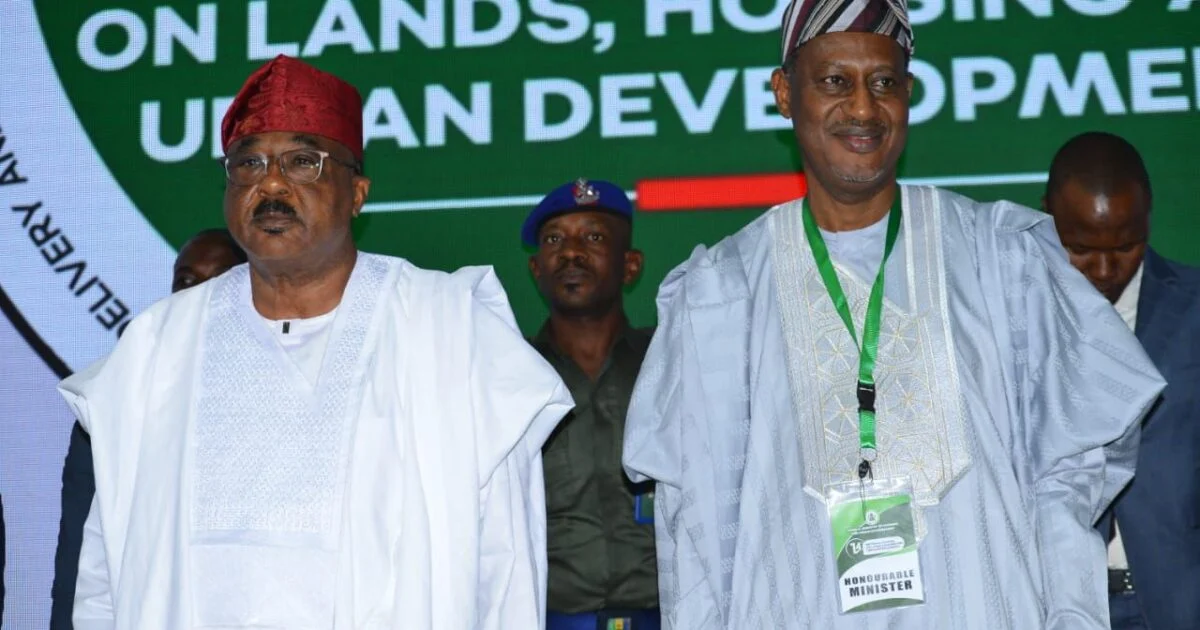

The Minister of Housing and Urban Development, Ahmed Dangiwa, has urged state governments, housing institutions, Development Finance Institutions and other stakeholders in the built environment to actively participate in and support the National Homeownership and Housing Development Campaign.
In a statement issued by the ministry on Sunday, the minister said the campaign is scheduled to commence on March 4 and 5, 2026, in Katsina State.
Dangiwa made the call while delivering a thematic address on Day Four of the 14th National Council on Lands, Housing and Urban Development, currently holding in Ilorin, Kwara State.
According to the minister, the campaign represents the ministry’s determination to lead “a unified and coordinated approach to subnational housing development, working closely with state governments to ensure that federal programmes, reforms, finance opportunities and private capital are translated into real, visible and deliverable projects at the state level.”
“I want to use this platform to call on all stakeholders—governors, commissioners, permanent secretaries, housing institutions, developers, financiers and professionals—to actively support and participate in this campaign, which will be flagged off in Katsina State from March 4 to 5, 2026,” Dangiwa said.
He urged stakeholders to see the initiative as a collective effort to drive sustainable homeownership across the federation.
The campaign, being organised by Know This Nigeria Network in collaboration with the Federal Ministry of Housing and Urban Development, is designed to connect federal housing reforms, policies and interventions with state-level implementation.
It will feature two major components—Regional Executive Sessions and Public Homeownership Seminars—aimed at strengthening linkages between Federal Housing Institutions, Development Finance Institutions and state governments.
Dangiwa noted that the initiative aligns with the ministry’s newly introduced Unified Housing Delivery Framework, which seeks to deepen collaboration between the Federal and State Governments in delivering housing at scale and building sustainable cities nationwide.
“Our new direction is to ensure that the ministry and all Federal Housing Institutions function as one government, delivering results that directly support state and local implementation efforts. This is to ensure that we operate not in silos, but as one coherent national housing delivery system working in direct support of state-level delivery”, he stated.
In his presentation at the council meeting, the National Coordinator of the campaign, QS Muhammed Baba Adamu, disclosed that Katsina State would host the North-West edition, which would serve as the inaugural outing of the nationwide programme.
He explained that a coordinated National Homeownership and Urban Development Campaign provides a practical framework for creating structured synergy between the ministry, Federal Housing Institutions, Development Finance Institutions and state governments.
“It provides clear and consistent platforms for awareness and engagement, and enables sustained interaction beyond one-off meetings or political cycles,” Adamu said.
He added that the campaign would also strengthen the capacity of states to attract, absorb and deploy housing capital more effectively.
“A central innovation of the campaign is the encouragement of states to establish State Housing Reform Offices. These offices will provide expert-level advisory and technical capacity within state governments, enabling them to convert opportunities into bankable and deliverable projects,” he noted.
The 14th National Council on Lands, Housing and Urban Development is the sector’s highest policy and decision-making forum, bringing together key actors across the housing and urban development ecosystem.
PUNCH Online reports that Nigeria faces one of Africa’s largest housing deficits, with millions lacking access to safe and affordable homes. Data from the Federal Ministry of Housing and Urban Development indicate that about 15.2 million housing units are structurally inadequate, highlighting challenges beyond new construction to include urban renewal and infrastructure upgrades.
Homeownership has long been constrained by complex land administration, limited financing and low awareness of federal housing schemes, making land titles difficult to obtain and mortgages largely inaccessible.
Under the administration’s Renewed Hope Agenda, the Federal Government has rolled out reforms, including public–private partnerships and institutional restructuring, to strengthen housing finance and delivery, shifting towards a private-sector-led model to close the housing gap.