
The Federal Government has honoured 12 teachers from across the country with national awards, reaffirming its commitment to strengthening the education sector through improved welfare, incentives, and professional development for teachers.
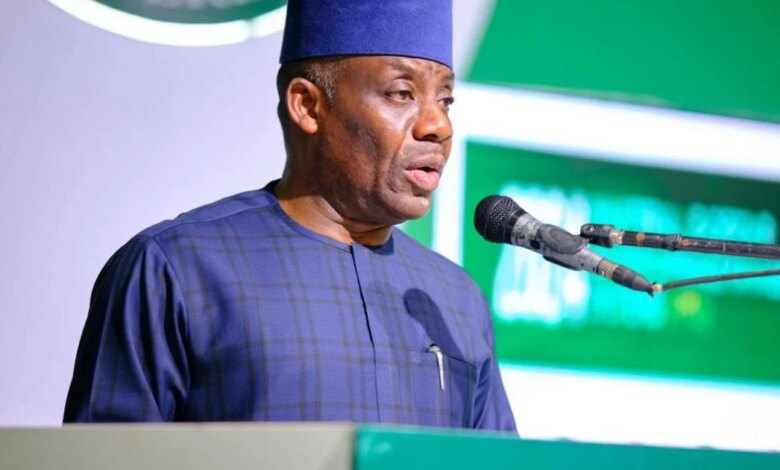
The awards were presented on Tuesday at the Nigeria Teachers’ Summit 2026, held in Abuja, where the Minister of Education, Dr Tunji Alausa, stated that the government would sustain reforms aimed at empowering teachers and restoring dignity to the profession.

Alausa explained that the selection process was transparent and merit-based, with three teachers nominated from each of the 36 states and the Federal Capital Territory at both the basic and senior secondary school levels.
From the pool of nominees, 12 teachers; six from basic education and six from senior secondary education, emerged as national award recipients.
Each of the 12 awardees received a cheque of N25m.
The Overall Best Teacher of the Year, Solanke Taiwo from the South-West category, received an additional N25m, bringing his total prize to N50m.
In addition to the cash prize, Taiwo is to receive a brand new car from the Governor of Borno State, Babagana Zulum, as well as a fully furnished two-bedroom flat from the Ogun State Governor, Dapo Abiodun.
Also, the Governor of Kebbi State, Nasir Idris, pledged to give each of the award winners an additional N5 million.
The minister described the awardees as exemplifying professionalism, integrity, innovation and dedication to learners, noting that they represent the best of the teaching profession in the country.
“This is more than a reward. It is a national signal that teaching is a noble, respected, and valued profession in Nigeria,” he said.
Speaking at the summit themed ‘Empowering Teachers, Strengthening the System: A National Agenda for Education Transformation and Sustainability,’ the minister said the recognition of the teachers reflected the FG’s broader education reform agenda under Tinubu’s Renewed Hope Agenda.
“Teachers are the foundation of education, and education is the foundation of national development. No nation can rise above the quality of its teachers.
“No reform, no matter how well designed, can succeed unless teachers are empowered, motivated, supported, and respected,” Alausa said.
He pledged that the government would continue to invest in teachers through structured training, improved career pathways and fair rewards, noting that education remained central to national development.
Under the Renewed Hope Agenda, he said, “sustainable development, economic growth, innovation, and social cohesion depend on a strong and responsive education system and that system depends on teachers.”
As part of this commitment, the minister announced the launch of EduRevamp, a nationally coordinated Continuous Professional Development programme designed to modernise teacher training and improve classroom outcomes.
While the programme is open to teachers in both public and private schools, Alausa said performance-based incentives would be reserved for public school teachers who complete certified training.
“Professional growth must never be restricted. Every teacher deserves access to quality training, modern tools, and updated skills,” he said, adding that incentives would be tied to measurable performance.
He also highlighted complementary initiatives, including the Ignite digital platform to reduce teacher workload, the Diaspora Bridge programme to strengthen STEMM education, and the provision of 60,000 tablets for teachers with zero-data access to approved training platforms.
The minister further announced reforms to the Teachers Registration Council of Nigeria’s digital platform, the expansion of Communities of Practice, and progress on the Accelerated Teacher Training Programme aimed at fast-tracking professionalisation for in-service teachers.
To provide long-term stability, he said the government had introduced a National Teacher Policy to guide teacher development, welfare and professional standards nationwide.
Addressing the award recipients and other educators at the summit, Alausa described the government’s message as “professional growth, dignity in service, and renewed hope,” urging stakeholders to focus on tangible outcomes in classrooms across the country.
In her welcoming remarks, the Minister of State for Education, Professor Suwaiba Ahmad, underscored the central role of teachers in Nigeria’s education reform agenda.
Ahmad said the gathering was both timely and strategic, noting that the quality of any education system is inseparable from the quality, motivation and empowerment of its teachers.
She explained that the theme aligns directly with Nigeria’s current education priorities. According to her, investing in teachers is the bedrock of sustainable reform and national development.
“Empowering teachers is not an isolated intervention; it is the foundation upon which sustainable education reform is built.
“When teachers are supported, trained, motivated, and valued, the entire system is strengthened, learning outcomes improved, equity expands, and national development is accelerated,” she said.
Describing the summit as a strategic national platform, the Don said it was designed to unite key stakeholders to address challenges in the education sector and advance practical reforms.
She noted that the forum brings together teachers, policymakers, education leaders, regulators, unions, development partners and private sector actors to strengthen teaching and learning outcomes nationwide.
In his goodwill message, the National President of the Nigeria Union of Teachers, Audi Amba, described the summit as a historic milestone in the recognition of teachers’ roles in national development.
Nigeria’s education sector has continued to grapple with longstanding challenges, particularly around teacher welfare, access to regular professional development, classroom capacity and infrastructure.
These issues have raised concerns among stakeholders about the quality of teaching and learning in many public schools. At the same time, industrial actions by education unions in recent years have further highlighted the pressures facing educators nationwide.